Imagine: it is a beautiful Christmas Eve. The sun has just sunk below the horizon and the trees are shivering outside in the cold. You, along with family and friends, are in church, hands being warmed by the candles you are holding and ears blessed with the congregation’s singing of the familiar Christmas tune, Silent Night. The words ring out: “All is calm, all is bright. Round yon virgin, mother and child.”
As soon as that verse finishes, an annoying voice breaks up the peaceful singing.
‘Ahem!’ Everyone ignores it.
‘AHEM!’ The noise is even louder. The worshippers, disrupted, look to the man making it.
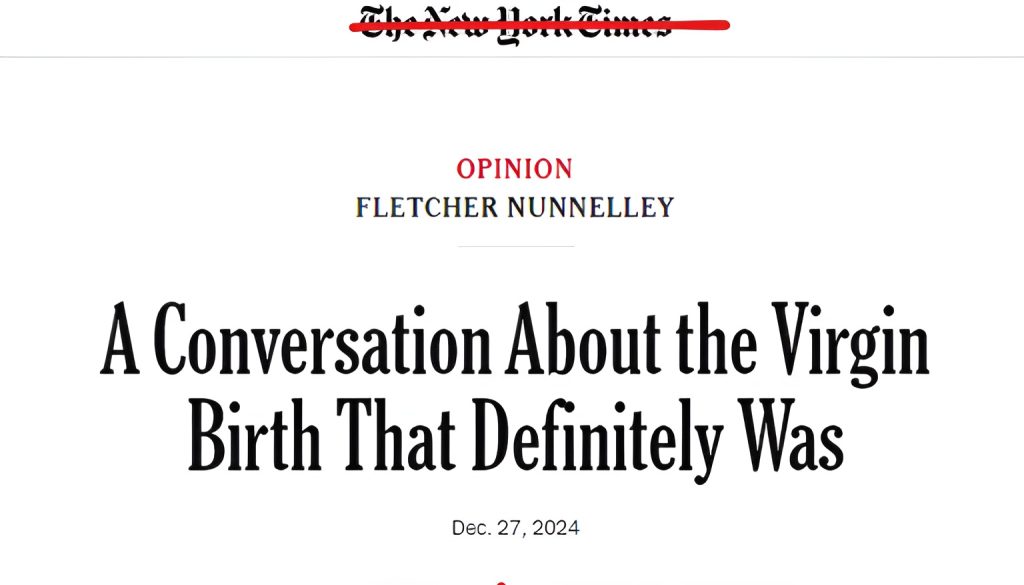
“Actually…” the man snickers, absorbed in the attention he’s finally won. “Mary could not have been a virgin, as everyone should know, that is obviously impossible.” The man says, smiling condescendingly at the churchgoers. He is none other than Nicholas Kristof… a journalist for the New York Times, who recently published a piece attacking the doctrine of Jesus’s Virgin birth.
This year, repeating the secular tradition of attacking the Christian faith during its Christmas season, Nicholas Kristof teamed up with Elaine Pagels for the New York Times to call into question one of the most central doctrines of Christian tradition, and one which is deeply important to the historical Christmas story: The Virgin Birth of Jesus Christ. Their article, “The Virgin Birth that Maybe Wasn’t,” argues that reality is far removed from the story many around the globe celebrate on Christmas day.
Pagels begins her assault on Christianity with the claims that because “Mark has no suggestion of a virgin birth” the scripture leaves open the possibility that Jesus had an earthly father. She goes on to claim that the Gospel writers Matthew and Luke were embarrassed by the paternal ambiguity left by Mark, and that they each invented contradictory Virgin Birth narratives as revisionist attempts to “reduce the embarrassment” of Jesus’s parentage. Pagels then forwards the theory on the identity of Jesus’ father in which she believes: that he was a Roman soldier named Pantera who raped Mary while the Roman army was occupying Galilee. Kristof correctly notes that these accusations cropped up among those who were “trying to disparage Jesus,” to which Pagels is forced to admit that the allegations were made “after Jesus’ death among members of the Jewish community who regarded him as a false messiah.” When questioned further by Kristof about the source material behind her claims, Pagels admits that she herself “used to dismiss such stories as ancient slander.”

Of course, the Gospels are clear about Jesus’s paternal origins. Matthew and Luke, two sources independent of each other, but both written within 40 years of the Crucifixion, affirm the Virgin Birth. For Pagels to deny these two sources simply because of hostile writings much further removed from the actual birth of Jesus is simply bad scholarship. She picks and chooses her sources based not on their reliability, but rather their suitability for her cause: to weaken and ultimately destroy the Christian faith.
Upon a close inspection, the sources that Pagels cites are far less reliable than the very scripture which she paints as revisionist and untrustworthy. Though she does not specifically lay out her research, it is evident that Pagels refutes ancient Christian doctrine using the Talmudic texts, Jewish sources dated hundreds of years after Christ’s birth, between the 3rd and 6th centuries. She likely refers to the writings of the philosopher Celsus as well; a Greek pagan whose career was dedicated to combating Christianity. Regardless of whether these texts are reliable, it is indisputable that they were written centuries after Christ by people who were hostile towards Him. While Pagels conveniently disregards the apostles as untrustworthy witnesses with little to no reason as to why, she chooses to trust sources that are far more temporally removed from the events of the Gospels, and are also very hostile towards the figures portrayed in them. Pagels is not a historian, she is an ideologue, through and through.
The sources that Pagels chooses to believe in are relatively new compared to the New Testament, and their verity is far more questionable. Out of all the documents of antiquity, from the writings of Cicero to Caesar’s De Bellico Gallico, none have anywhere near the amount of surviving documents as the New Testament. For example, the next most well-documented ancient text behind the New Testament is the Iliad, with 650 remaining ancient documents. There are 24,000 remaining ancient copies of the New Testament. If we are being generous, there are 68 remaining copies of the Talmud, and even fewer copies of the other sources which Pagels cites. This serves to illustrate that Pagels has chosen as her authority on the Nativity a small collection of fringe, poorly-preserved documents, whose authors hated Christianity. Pagels has built her house on sand: she raises flimsy libel to a high standard of authority while denigrating the earlier Gospels as unreliable simply for the sake of her ideology.
Kristoff and Pagels are not alone in their dogmatic assault on the faith. Each Christmas season, major legacy media publications use their platforms to attack Christianity and disrupt the peace, joy, and serenity of this most holy day of the liturgical year, repeating age-old anti-Christian invectives that have repeatedly failed to move the needle over the last 2000 years. It need not even be touched upon that the media does not air similarly styled criticisms before the holy days of other religions, such as Diwali, Hanukkah, or Ramadan.
The natural question is why? It does not take much research to see that Pagels’ specific critique of the faith lacks substance and depth. In the thousands of years that it’s been employed, the ‘Pantera’ argument has not, and will not, change any minds. It simply lacks the evidence to do so. Yet, the New York Times, named after a city that once jumped at the chance to light up the skyline with Crosses, lusts after the opportunity to make any assault on Christianity, no matter how flimsy or disingenuous it may be.
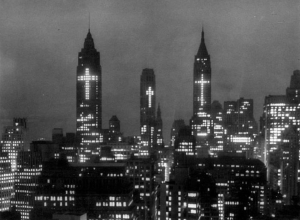
New York City in 1956.